Gut Microbiome Test: Do You Actually Need One? An Honest Look at What They Tell You — And What They Don’t
Microbiome tests are everywhere. They promise deep insight into your gut health. But before you spend $100–$400, here’s what the research actually says about their usefulness.
Illustration: The gap between what microbiome tests measure and what they can actually tell you
“A test told me I had ‘low Bifidobacterium.’ I had no idea what to do with that information. Neither did my doctor, honestly.”
That’s a pretty common experience. Microbiome testing has exploded in the US over the last few years — companies like Viome, Thryve, Ombre, and Zoe are spending heavily on ads, and they’re good at making their tests sound essential. And they’re not entirely wrong — understanding your gut bacteria is genuinely interesting and the science behind microbiome testing is real.
But interesting and actionable are two different things.
This article is not a pitch for or against microbiome testing. It’s an honest look at what these tests can and can’t do, who they actually help, and — if you decide to skip the test — what you can do right now that will likely make more difference anyway.
🎯 Quick Answer: Do You Need a Gut Microbiome Test?
For most people, no — not right away. Gut microbiome tests can identify bacterial diversity and flag potential imbalances, but their clinical utility is still limited. The same dietary and lifestyle changes that improve results on a test also improve how you feel — whether or not you test first. Testing makes most sense after trying evidence-based gut health fundamentals for 8–12 weeks.
What a Gut Microbiome Test Actually Does
At its core, a microbiome test analyzes a stool sample to identify which bacteria, yeasts, and other microorganisms are present in your gut — and in what relative proportions. Most consumer tests use a technology called 16S rRNA gene sequencing, which identifies bacteria by reading a specific genetic marker. More expensive tests use whole genome sequencing (metagenomics), which gives a more detailed picture.
You swab a sample, mail it to a lab, and receive a report — usually within two to four weeks — showing your bacterial diversity score, the relative abundance of different bacterial families, and sometimes a comparison to a reference population.
That part is genuinely impressive from a scientific standpoint. Ten years ago this kind of analysis didn’t exist outside of research institutions.
The question isn’t whether the technology works. It’s whether the results are useful enough to justify the cost — and that’s where things get more complicated.
The Main Types of Tests Available in the US
🧬 Consumer Microbiome Tests ($99–$199)
The most widely marketed option. Companies like Viome, Ombre, and Thryve mail you a collection kit, analyze your sample, and send a report with dietary recommendations. The reports are often detailed and visually impressive. The science behind them varies considerably.
These tests are generally best for curiosity and general awareness. The personalized dietary recommendations they generate are based on population averages and algorithms, not individualized clinical data.
🏥 Clinical Stool Testing ($200–$500+)
Ordered through a gastroenterologist or functional medicine practitioner. Tests like the GI-MAP or Genova GI Effects analyze not just bacteria but also digestive enzymes, inflammatory markers, gut lining proteins (like zonulin — a leaky gut marker), parasites, and short-chain fatty acid production. Significantly more actionable than consumer tests.
If you have persistent, unresolved digestive symptoms — chronic bloating, unexplained diarrhea, suspected SIBO — this is the type of test worth pursuing, with a practitioner who can interpret and act on the results.
🔬 Research-Grade Testing (Academic / NHS programs)
Programs like the American Gut Project (a citizen science initiative) offer whole-genome sequencing at a lower cost in exchange for contributing to research. These provide the most detailed bacterial picture available to consumers — but the reports are complex and designed for research purposes, not personal health guidance.
What the Results Actually Tell You — And What They Don’t
This is the part most marketing materials gloss over. And honestly, it matters more than people realize.
What a Test Can Reasonably Show You
- Which bacterial families are present in your gut at that moment
- A rough measure of microbial diversity — more diversity is generally better
- Relative abundance of certain well-studied species (like Akkermansia muciniphila or Faecalibacterium prausnitzii)
- Whether you have significantly elevated levels of potentially pathogenic bacteria
What a Test Cannot Reliably Tell You
- Whether those bacteria are active (present ≠ functioning)
- What “normal” looks like for your specific body
- Exactly which foods you should eat or avoid
- Whether your gut health is “good” or “bad” overall
- What your microbiome will look like next month
There is currently no universally agreed-upon definition of a “healthy” microbiome. The research field is still building that understanding. What a test can do is compare your results to a reference population — but that population varies by lab, by study, and by methodology. Two different companies can test the same stool sample and produce different conclusions.
A 2019 study published in Cell Host & Microbe found that gut microbiome composition is highly individual — more influenced by diet, environment, and lifestyle history than by any universal standard. In other words, what’s “optimal” for you may look quite different from what’s optimal for someone else.
The Real Limitations Nobody Talks About
Consumer microbiome companies do a good job of making their reports look authoritative. The colorful charts, the percentage breakdowns, the personalized food lists — it all feels very scientific. And to be fair, the underlying technology genuinely is impressive.
But here’s what the fine print doesn’t emphasize.
The Snapshot Problem
Your gut microbiome is not static. It shifts meaningfully within 24–48 hours based on what you ate, how well you slept, your stress levels, and even physical activity. A single test captures one moment. If you tested again after a week of eating differently, your results would look different. This doesn’t make the test useless — but it does mean you shouldn’t treat it as a fixed picture of your “gut health.”
The Interpretation Gap
Most consumer tests give you a report but not a roadmap. Knowing you have “low Bifidobacterium” or “high Firmicutes ratio” sounds informative. But translating that into specific, personalized actions requires clinical expertise that most reports don’t provide — and that most people’s doctors aren’t yet trained to interpret.
The Reference Range Problem
Each testing company uses its own reference population for comparison. There is no standardized “normal” gut microbiome database in the way there is for, say, blood cholesterol levels. So when a report says your diversity score is “below average,” you’re being compared to a proprietary reference group — not a universal clinical standard.
Myth: “My test showed I’m missing X bacteria, so I should take X probiotic supplement.”
Reality: Most probiotic strains don’t permanently colonize the gut. Adding a specific bacterial strain via supplement rarely “fixes” a deficiency shown on a test — because the underlying conditions that depleted those bacteria in the first place (diet, stress, medications) haven’t changed.
So — Is a Gut Microbiome Test Actually Worth It?
Honest answer: it depends on what you’re looking for and what you plan to do with the results.
If you’re curious, motivated by data, and want a baseline snapshot of your bacterial diversity — a consumer test can be interesting and occasionally illuminating. Some people find it genuinely motivating to see their diversity score improve after dietary changes. That’s real value.
But if you’re hoping a test will tell you exactly what’s wrong and exactly what to do about it — you’ll likely be disappointed. The more useful tests (clinical stool panels with practitioner guidance) do exist, but they require a functional medicine doctor or gastroenterologist, and insurance rarely covers them.
For most people dealing with digestive symptoms — bloating, fatigue, skin issues, irregular digestion — the evidence-based dietary and lifestyle changes that improve gut health work regardless of what a test shows. You don’t need to know your Firmicutes-to-Bacteroidetes ratio to benefit from eating more fermented foods and less refined sugar.
🎯 Featured Snippet: Are Gut Microbiome Tests Worth It?
Consumer microbiome tests ($99–$199) can show bacterial diversity and flag potential imbalances, but have limited clinical utility for most people. Clinical stool tests ordered through a gastroenterologist are more actionable for persistent symptoms. For most people, implementing evidence-based dietary changes produces measurable gut health improvements — no test required first.
Who Actually Benefits From Microbiome Testing?
Testing makes the most sense in specific situations — not as a first step for everyone.
People with persistent, unresolved gut symptoms
If you’ve tried dietary improvements for 3–6 months and still have significant bloating, irregular digestion, or unexplained fatigue, a clinical stool panel (GI-MAP or similar) ordered through a functional medicine practitioner can identify specific issues — SIBO, dysbiosis patterns, leaky gut markers — that dietary changes alone may not address.
Post-antibiotic recovery
If you’ve had a significant course of antibiotics and want to understand the extent of microbiome disruption, testing before and after a recovery protocol can be informative. Though again — the recovery protocol itself (fermented foods, fiber diversity, probiotic supplementation) doesn’t require a test to implement.
People who are data-motivated
Some people genuinely find data motivating. If seeing a diversity score improve over time helps you stay consistent with dietary changes — that’s legitimate value. Just don’t treat the test as a diagnosis or a prescription.
Before and after a structured gut protocol
Testing before starting a gut-healing program — and again after 12 weeks — can show measurable changes in diversity and specific bacterial populations. This is probably the most genuinely useful application of consumer testing for the average person.
What to Do If You Skip the Test (Or Can’t Afford One)
Here’s something that doesn’t get said enough: the dietary and lifestyle changes with the strongest evidence for improving gut microbiome health don’t require a test to identify or implement. You don’t need to know which specific bacteria you’re low in to benefit from eating more fermented foods and fiber.
The research is remarkably consistent on what builds a healthier microbiome:
- Eating 30+ different plant foods per week (the American Gut Project’s strongest finding)
- Daily consumption of refrigerated fermented foods with live cultures
- Reducing refined sugar, ultra-processed food, and emulsifiers
- Consistent sleep — same bedtime, 7–9 hours
- Managing stress through movement, breathing, or whatever works for you
- Moderate, regular physical activity
None of those require a $150 test to identify. They require consistency.
That said — if you want a structured starting point, we put together a 7-day gut reset protocol specifically for this situation. It’s science-based, beginner-friendly, and designed to help you build these habits in a practical, realistic way.
🌿 Start Your Gut Reset — No Test Required
The GlowGut40 7-Day Gut Reset Guide gives you a complete, day-by-day protocol: meal plans, gut-healing habits, a full shopping list, and bonus guides on snacking and eating out. Everything you need to start improving digestive wellness — without waiting for a test result.
Get the 7-Day Gut Reset Guide →Signs Your Microbiome Needs Attention — No Test Required
Your body gives signals long before any test would. These are the ones worth paying attention to:
- 🫧 Bloating after most meals — particularly after foods you used to handle fine
- 😴 Persistent fatigue that doesn’t improve with more sleep
- 🧠 Brain fog — that fuzzy, unfocused feeling that lingers through the day
- 🤒 Skin flare-ups — acne, eczema, or rosacea that won’t respond to topical treatment
- 🍬 Intense sugar cravings after eating — a classic sign of dysbiosis-driven bacterial manipulation
- 😤 Mood instability — anxiety or low mood without an obvious external cause
- 🚽 Irregular digestion — alternating between constipation and loose stools
Three or more of these showing up regularly is a meaningful signal. Not a diagnosis — but a clear invitation to take digestive health seriously. See our full guide: 7 Warning Signs of an Unhealthy Gut →
Start Without a Test: The Practical First Step
If you’re reading this and wondering where to actually begin — the answer is simpler than a microbiome test. Start with a structured 7-day protocol that addresses the dietary and lifestyle fundamentals.
Here’s the general framework of what works:
Remove the main disruptors
Refined sugar, ultra-processed food, alcohol. Just for 7 days to start. The shift is noticeable faster than most people expect.
Add one fermented food daily
Plain kefir, sauerkraut, kimchi, or yogurt. Refrigerated. Consistent. Small amounts are fine to start.
Increase plant diversity
Aim for a different vegetable or fruit each day. Variety matters as much as volume.
Protect sleep
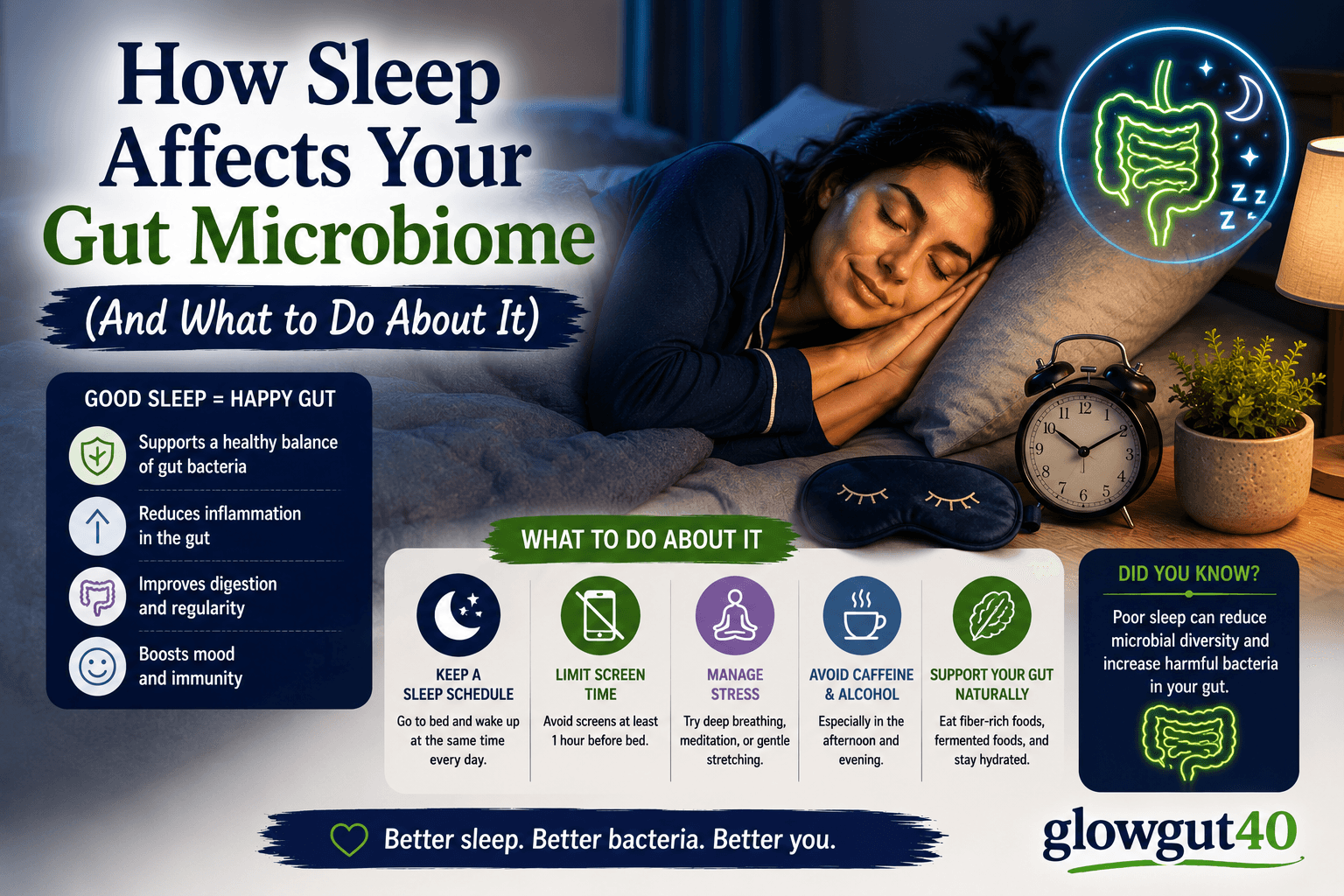
Same bedtime. No screens 60 minutes before bed. The gut does most of its repair work overnight.
Walk after meals
15–20 minutes. Reduces post-meal blood sugar spikes and supports gut motility. Simple and free.
📗 Want the Complete Day-by-Day Protocol?
The GlowGut40 7-Day Gut Reset Guide has everything laid out: full meal plans for each day, a complete shopping list, supplement guidance, bonus snack ideas, and a restaurant ordering guide. Designed for busy women who want practical steps — not another thing to research.
Download the 7-Day Gut Reset Guide →⚠️ Mistakes People Make Around Gut Testing
Testing first and eating well second is backwards for most people. The foundational changes — more plant diversity, daily fermented foods, less sugar — will improve your gut health whether or not you know your baseline. Test results are more meaningful and actionable after you’ve built those habits for at least 8 weeks.
Consumer microbiome tests are wellness products, not clinical diagnostic tools. A report saying you’re “low in Akkermansia” is not the same as a doctor telling you you have a specific condition. The information is interesting — it’s not a prescription.
This is where companies make a lot of their money — suggesting you need their proprietary probiotic blend based on your test. The honest reality: whole fermented foods contain far more diverse bacterial strains than any supplement, and the dietary changes that shift your microbiome are more fundamental than adding a capsule of a specific strain.
Your microbiome changes constantly. A test is a snapshot, not a fixed profile. People sometimes get a test, make changes, feel better — and never retest to see if things improved. If you’re going to test, test twice (before and after a protocol) to actually see the impact of your changes.
❓ Frequently Asked Questions
For consumer tests, Viome and Ombre are among the most widely used and have reasonably detailed reports. For clinical value, the GI-MAP (from Diagnostic Solutions) and Genova GI Effects are more comprehensive — but these need to be ordered through a practitioner. The “best” test depends on your goal: if you want curiosity and general insight, a consumer test is fine. If you have persistent symptoms and want clinically actionable data, pursue a clinical stool panel through a functional medicine practitioner or gastroenterologist.
The laboratory technology is generally accurate at identifying which bacteria are present. The limitation isn’t the technology — it’s the interpretation. There’s no universal standard for a “healthy” microbiome, reference populations vary between companies, and the dietary recommendations generated from results are based on population averages rather than individual clinical assessment. Two reputable companies testing the same sample can produce different conclusions, which tells you something important about the current state of consumer interpretation.
Standard consumer microbiome tests don’t test for leaky gut (intestinal permeability) directly. Clinical stool tests like the GI-MAP can measure zonulin — a protein that’s elevated when gut permeability is increased — and other markers of gut lining integrity. If you specifically want to assess leaky gut, a clinical panel ordered through a practitioner is more appropriate than a consumer microbiome test. Alternatively, blood tests measuring LPS or zonulin can also be ordered through some functional medicine practitioners.
The evidence-based approach doesn’t require knowing your specific bacterial profile first. Eat at least 30 different plant foods per week, consume one refrigerated fermented food daily (plain kefir, yogurt, kimchi, or sauerkraut), reduce refined sugar and ultra-processed food, prioritize consistent sleep, manage chronic stress, and walk regularly. These changes consistently improve microbiome diversity and digestive resilience across populations — regardless of starting point. For a structured day-by-day approach, the GlowGut40 7-Day Gut Reset Guide provides a complete practical protocol.
Consumer microbiome tests (Viome, Ombre, etc.) are generally not covered by insurance. Clinical stool panels may be partially covered when ordered by a physician for a specific diagnostic purpose — but this varies considerably by insurance plan. Some functional medicine practitioners offer microbiome testing as part of a broader panel that may have partial coverage. If cost is a concern, focusing on the dietary and lifestyle fundamentals is genuinely the most cost-effective approach to improving digestive health.
If you decide to test, the most useful approach is testing before and after a structured dietary protocol (at least 12 weeks apart) to measure change. Testing more frequently than every 3–4 months provides limited additional insight given how dynamic the microbiome is. Annual testing as a general check-in makes more sense than quarterly testing for most people. And remember — how you feel, your digestion quality, energy levels, and symptom patterns are all useful real-world signals that don’t require a test to interpret.
Final Thoughts: Test If You Want — But Don’t Wait
Microbiome testing is genuinely interesting. The science is real, the technology works, and for some people in specific situations, testing provides useful information.
But it’s not a prerequisite for improving your gut health. And for most people, the honest answer is: you don’t need one right now.
What you need is to start. Pick one fermented food and eat it daily. Add more plant variety to your meals this week. Cut the diet soda and the sugar-free gum. Walk after dinner. These changes improve your microbiome whether you can name your bacteria or not.
If you want a structured way to do that — one that takes the guesswork out of where to start — the 7-Day Gut Reset Guide is there when you’re ready.
The best gut health protocol is the one you actually follow. Start there.
🌿 Ready to Start? Skip the Wait.
The GlowGut40 7-Day Gut Reset Guide gives you a complete, practical protocol — no test needed. Meal plans, habits, shopping list, and two bonus sections included. Designed for real life.
Get the 7-Day Gut Reset Guide →More Gut Health Guides on GlowGut40
Evidence-based, honestly written, and designed for women who want real answers — not wellness hype.
