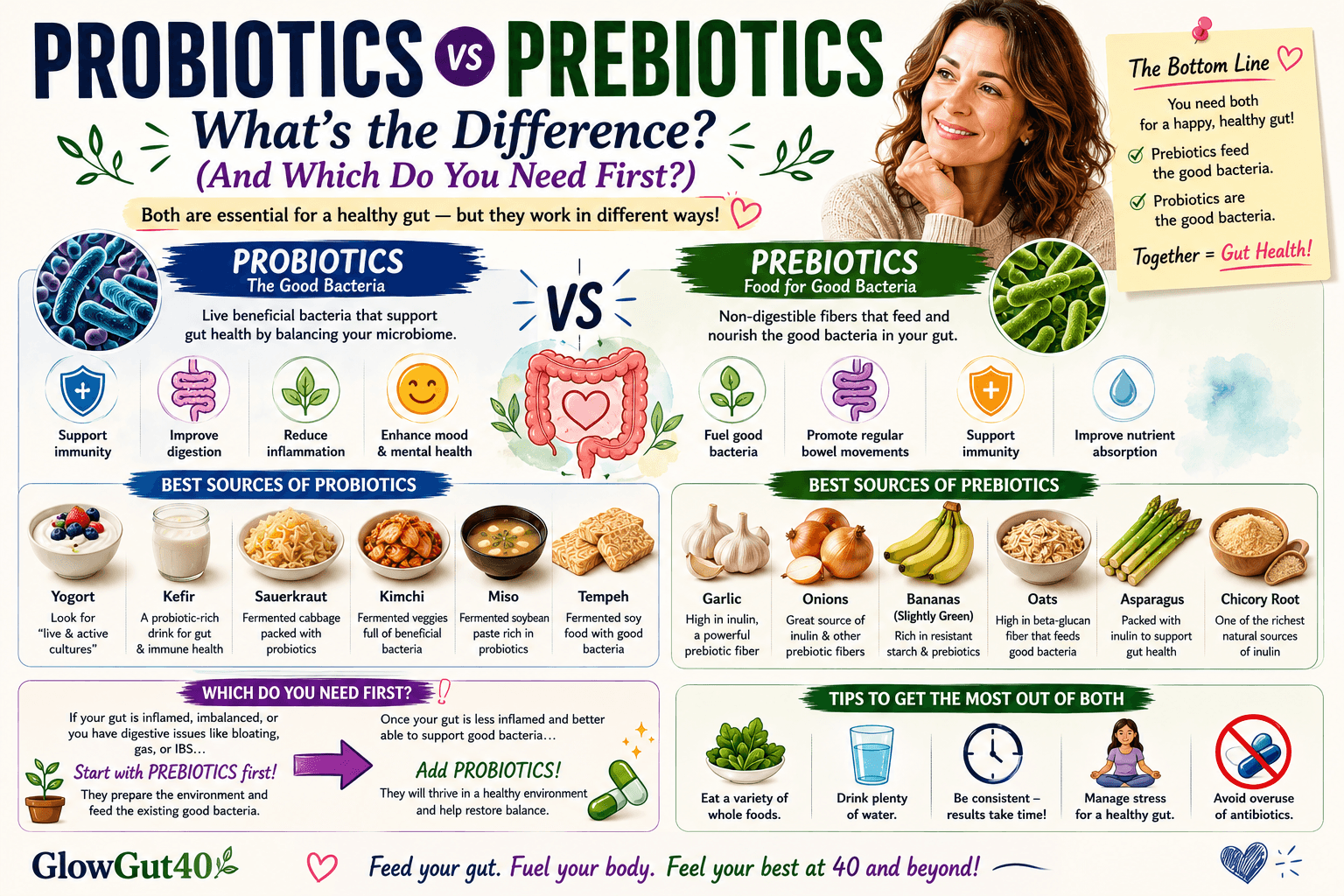
Probiotics vs Prebiotics: What’s the Difference? Which One Do You Actually Need First?
Most Americans are buying the wrong thing at the supplement store. Here’s the science-backed truth about probiotics vs prebiotics — and the right order to take them.
Illustration: Prebiotics feed bacteria. Probiotics ARE the bacteria. Together they’re called Synbiotics.
“I’ve been taking probiotics for months but nothing’s changed.” Sound familiar? The problem might not be the probiotics — it might be that you’re forgetting the prebiotics entirely.
Walk into any Walmart, Whole Foods, or CVS in America and you’ll find entire shelves dedicated to probiotics vs prebiotics. But most shoppers — and even many doctors — use these terms interchangeably. They are not the same thing, and confusing them could be the reason your gut health isn’t improving.
Here’s the simplest way to understand it: probiotics are the beneficial bacteria themselves, while prebiotics are the food that feeds those bacteria. Taking probiotics without prebiotics is like planting seeds in soil with no nutrients. The seeds might survive — but they won’t thrive.
In this guide, we’re going to break down the difference between probiotics vs prebiotics in plain English, explain exactly how each one works in your gut, and give you a clear action plan for getting the most out of both.
What Are Prebiotics? (The Gut’s Fertilizer)
Prebiotics are a type of dietary fiber that your body cannot digest — but your gut bacteria can. They pass through your stomach and small intestine intact, arriving in your large intestine (colon) where they become food for beneficial bacteria.
Think of your gut like a garden. Prebiotics are the fertilizer and water. Without them, even the best probiotic bacteria can’t survive long enough to make a difference.
The most well-studied prebiotic compounds include:
- Inulin — found in garlic, chicory root, and Jerusalem artichokes
- Fructooligosaccharides (FOS) — found in bananas, onions, and leeks
- Galactooligosaccharides (GOS) — found in legumes and certain dairy
- Beta-glucan — found in oats and barley
- Resistant starch — found in cooked-and-cooled rice, green bananas, and lentils
According to the NIH, when prebiotics are fermented by gut bacteria, they produce short-chain fatty acids (SCFAs) like butyrate — powerful compounds that reduce gut inflammation, improve insulin sensitivity, and even help burn belly fat. (Learn more in our guide: How Gut Health Affects Belly Fat →)
Illustration: Prebiotic foods → bacteria growth → SCFA production → gut healing
What Are Probiotics? (The Gut’s Beneficial Bacteria)
Probiotics are live microorganisms — primarily bacteria and some yeasts — that, when consumed in adequate amounts, provide a health benefit to the host. In plain terms: probiotics are the actual good bacteria you’re adding to your gut.
The two most well-researched probiotic families are:
- Lactobacillus — found in yogurt, kefir, and many supplements. Supports digestion, reduces bloating, and helps produce lactic acid.
- Bifidobacterium — found in aged cheeses, kefir, and supplements. Protects the gut lining, reduces inflammation, and is particularly important after antibiotic use.
The World Health Organization (WHO) officially defines probiotics as “live microorganisms which when administered in adequate amounts confer a health benefit on the host.” The key phrase is adequate amounts — most studies showing benefits use doses of at least 1 billion CFUs (colony forming units) per day.
Probiotics work by: competing with harmful bacteria for space and food, producing antimicrobial substances that kill pathogens, strengthening the gut lining to prevent leaky gut, and modulating the immune system. Learn more: Leaky Gut Syndrome: How Probiotics Help →
Probiotics vs Prebiotics: Key Differences at a Glance
Here is the clearest side-by-side comparison of probiotics vs prebiotics:
| Factor | PREBIOTIC | PROBIOTIC |
|---|---|---|
| What it is | Non-digestible fiber / food | Live beneficial bacteria |
| What it does | Feeds and grows good bacteria | Adds new good bacteria to gut |
| Found naturally in | Garlic, onions, oats, bananas | Yogurt, kefir, kimchi, sauerkraut |
| Survives stomach acid | ✅ Yes — fiber is resistant | ⚠️ Partially — some strains die |
| Needs refrigeration | ❌ No | ✅ Usually yes (supplements) |
| Works without the other | ⚠️ Less effective alone | ⚠️ Less effective alone |
| Speed of effect | Slower (builds foundation) | Faster (immediate introduction) |
| Who needs it most | Everyone — especially low-fiber eaters | After antibiotics, gut illness, travel |
| Best whole food sources | Chicory root, leeks, asparagus | Kefir, miso, kimchi, kombucha |
| Supplement form | Inulin, FOS, GOS, psyllium husk | Lactobacillus, Bifidobacterium strains |
How Probiotics and Prebiotics Work Together
Here’s the analogy that makes everything click: probiotics are the fish, prebiotics are the water. You can add all the fish you want to a tank — but if the water quality is poor, the fish won’t survive.
When you consume probiotics without adequate prebiotic fiber in your diet, the beneficial bacteria struggle to colonize your gut. They may pass through within days without making a lasting impact. This is why many people say “probiotics don’t work for me” — they’re adding bacteria to an environment that can’t sustain them.
A landmark 2019 study published in Cell (Stanford University) found that combining probiotic-rich and fiber-rich foods produced significantly more microbiome diversity and reduced inflammatory markers than either approach alone. The synergy is real and scientifically documented.
Illustration: Probiotics need a prebiotic-rich environment to survive and colonize
Best Prebiotic Foods to Add to Your Diet
The best prebiotic foods are those rich in inulin, FOS, resistant starch, or beta-glucan. All of these are easily available at American grocery stores:
For a full breakdown with recipes: 10 Best Foods for Gut Health →
Best Probiotic Foods to Eat Daily
These foods contain live, active bacterial cultures. Look for labels that say “live and active cultures” or “naturally fermented” — not pasteurized, which kills the bacteria:
What Are Synbiotics? (Probiotics + Prebiotics Together)
When you combine probiotics and prebiotics together — either in food, a meal, or a supplement — the result is called a synbiotic. This combination is significantly more effective than either alone.
A 2021 review in the Journal of Nutrition found that synbiotic interventions produced greater improvements in gut microbiome diversity, reduced inflammatory markers, and better metabolic outcomes compared to probiotics or prebiotics used separately.
Illustration: Synbiotics — the most powerful gut health combination
Easy synbiotic meal ideas:
- Oat porridge (prebiotic) + Greek yogurt topping (probiotic)
- Lentil soup (prebiotic) + side of kimchi (probiotic)
- Banana smoothie (prebiotic) + kefir base (probiotic)
- Garlic-roasted vegetables (prebiotic) + miso dressing (probiotic)
Which Should You Take First — Probiotics or Prebiotics?
This is the question everyone asks — and the answer is clear: start with prebiotics first.
Here’s why: if your gut environment isn’t supportive, introducing probiotic bacteria is largely pointless. They’ll arrive in an inhospitable environment and be flushed out within days. Think of it as preparing the soil before planting seeds.
Build Your Prebiotic Foundation
Increase fiber intake gradually to 25–38g/day. Add garlic, onions, oats, and bananas to your daily meals. This creates the bacterial environment that probiotics need to survive.
Introduce Probiotic Foods Daily
Once your prebiotic foundation is in place, add one probiotic-rich food per day — kefir, kimchi, or plain Greek yogurt. The bacteria now have fertile ground to colonize.
Combine Both Daily (Synbiotic Approach)
Eat both prebiotic and probiotic foods at each meal where possible. This is the synbiotic approach — and research shows it produces the most dramatic improvements in gut microbiome diversity.
🧮 Not Sure What YOUR Gut Needs Right Now?
Take the free GlowGut40 Gut Score Calculator and get a personalized gut health action plan. Check My Gut Score Free →Probiotic & Prebiotic Supplements: What to Look For
Whole food sources are always preferable. But if you’re using supplements, here’s what the research says to look for:
For Probiotic Supplements:
- CFU count: Minimum 10 billion CFUs for therapeutic effect
- Multiple strains: Look for both Lactobacillus AND Bifidobacterium strains
- Guaranteed live at expiry: Not just “at time of manufacture”
- Enteric coating: Helps bacteria survive stomach acid
- Third-party tested: NSF, USP, or ConsumerLab certified
For Prebiotic Supplements:
- Inulin or FOS: Most research-backed prebiotic fibers
- Psyllium husk: Excellent for both gut health and cholesterol
- Start low: Begin with 3–5g/day and increase slowly to avoid gas
- Check for fillers: Avoid supplements with artificial sweeteners
⚠️ Common Mistakes People Make
Coffee is acidic and can kill probiotic bacteria. Take probiotics with or just before a meal — food buffers stomach acid and dramatically improves bacterial survival rates.
Microbiome changes take time. Most clinical studies run 4–8 weeks before measuring results. Give your gut at least 30 days of consistent effort before judging whether it’s working.
Different strains have different benefits. L. acidophilus helps with digestion. L. rhamnosus supports weight management. B. longum reduces anxiety. Always match the strain to your specific health goal.
If you go from zero fiber to 30g overnight, you’ll feel bloated and gassy for days. Increase prebiotic fiber by 3–5g per week to let your microbiome adjust gradually.
Many store-bought kimchi and sauerkraut brands are pasteurized — which kills all bacteria. Look for “naturally fermented,” “unpasteurized,” or “raw” on the label. Refrigerated versions in health food stores are your best bet.
❓ Frequently Asked Questions
Probiotics are live beneficial bacteria that you add to your gut through food or supplements. Prebiotics are non-digestible fibers that feed and help grow those bacteria. Think of probiotics as the fish and prebiotics as the water — you need both, but the water quality (prebiotics) must be established first.
Yes — and it’s actually the most effective approach. Taking them together is called the “synbiotic” method. For example, eating oatmeal (prebiotic) with Greek yogurt (probiotic) is a simple, powerful synbiotic meal. Research shows synbiotics produce significantly better gut health outcomes than either alone.
Neither is “better” — they serve different functions. However, if you’re starting from scratch, prebiotics should come first since they create the environment that allows probiotics to thrive. Most Americans are severely deficient in prebiotic fiber (eating only 10–15g vs. the recommended 25–38g daily), making prebiotics the more urgent priority for most people.
Food-first is always the preferred approach. Whole food sources of probiotics (kefir, kimchi, yogurt) and prebiotics (oats, garlic, bananas) come with additional nutrients and compounds that enhance their effectiveness. Supplements are useful for specific therapeutic goals, after antibiotic use, or when diet alone isn’t sufficient — but they should complement, not replace, a gut-healthy diet.
Bloating and digestive improvements can appear within 1–2 weeks. Measurable microbiome diversity changes typically occur within 4–6 weeks of consistent intake. Energy, skin, and mood improvements from a healthier gut may take 6–12 weeks to fully manifest. Consistency is the most important factor — results compound over time.
For most people, yes. However, people with IBS (irritable bowel syndrome), SIBO (small intestinal bacterial overgrowth), or severe fructose malabsorption may find certain prebiotic fibers (particularly FOS and inulin) trigger symptoms. If you have a digestive condition, consult your gastroenterologist before significantly increasing prebiotic fiber intake.
Final Thoughts: Probiotics vs Prebiotics — You Need Both
The great probiotics vs prebiotics debate has a simple answer: stop choosing sides. Your gut needs both — working together — to achieve lasting health.
Probiotics introduce the beneficial bacteria. Prebiotics ensure those bacteria have the nourishment and environment to survive, multiply, and actually make a difference in your gut. Together, as synbiotics, they represent the most powerful, evidence-based approach to gut healing available today.
Start with food. Add garlic to your cooking. Eat oats for breakfast. Try a small serving of kefir each day. These simple, affordable changes — done consistently — will do more for your gut than any expensive supplement taken in an unhealthy gut environment.
Your gut is ready to heal. Give it both the seeds and the soil.
Ready to Build a Healthier Gut Starting Today?
Explore the complete GlowGut40 gut health library — science-backed guidance for women over 40.
