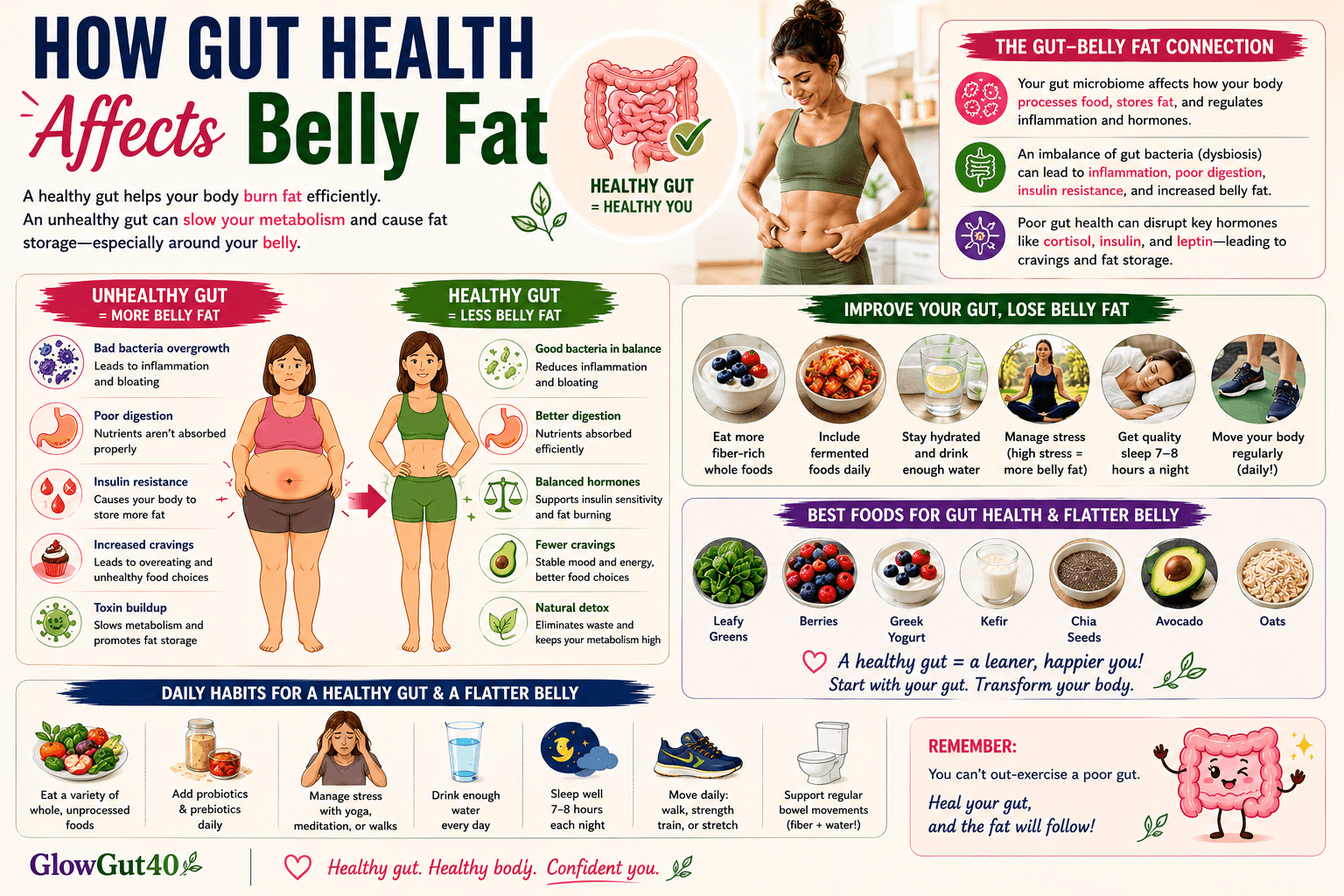
How Gut Health Affects Belly Fat And What You Can Do About It Today
Science-backed, practical advice for Americans looking to understand the gut-fat connection — and finally do something about it.
Illustration: How gut bacteria influence fat storage around the belly
Picture this: You’ve been eating salads, logging your steps, and drinking your water. But that stubborn belly fat? Still there. Mocking you every morning.
If that sounds familiar, you’re in very good company. According to the CDC, nearly 42% of American adults are classified as obese — and belly fat (visceral fat) is one of the most stubborn and dangerous forms.
But here’s what most weight loss advice gets completely wrong: It’s not always about eating less or moving more. Sometimes, it’s about what’s happening inside your gut.
In the past decade, scientists have made one of the most exciting discoveries in metabolic health: your gut microbiome — the trillions of bacteria, fungi, and microbes living in your digestive tract — has a profound influence on how your body stores fat, manages hunger, and controls inflammation.
What Is the Gut Microbiome — And Why Should You Care?
Illustration: Your gut microbiome — trillions of microbes along your digestive tract
Your gut is home to roughly 38 trillion microorganisms — more than the number of human cells in your entire body. This community of bacteria, viruses, fungi, and microbes is your gut microbiome.
These aren’t passive passengers. They actively digest your food, produce vitamins, train your immune system, communicate with your brain, and — here’s the big one — regulate your metabolism and fat storage.
The NIH Human Microbiome Project has shown that each person’s microbiome is as unique as a fingerprint. Depending on what’s living in yours, your body may be predisposed to burning fat efficiently or storing it — especially around the belly.
The Gut-Fat Axis: A Two-Way Street
Scientists now refer to the relationship between the gut and fat tissue as the “gut-adipose axis.” Your gut bacteria send chemical signals that tell your fat cells how to behave. An imbalanced microbiome (called dysbiosis) can instruct your fat cells to grow — particularly visceral fat around your organs.
The Mayo Clinic warns that visceral fat isn’t just cosmetic. It’s metabolically active tissue that releases inflammatory chemicals linked to heart disease, type 2 diabetes, and hormonal disruption.
How Gut Health Directly Affects Belly Fat: 5 Key Mechanisms
Illustration: The 5 mechanisms connecting gut health to belly fat
Gut Bacteria Control How Many Calories You Extract
Different bacterial species extract different amounts of energy from the same food. A landmark study published in Nature found that obese individuals had more Firmicutes bacteria and fewer Bacteroidetes. Firmicutes are particularly efficient at harvesting calories — meaning someone with more of them gains more weight from the same meal.
Leaky Gut Triggers Chronic Inflammation
When the gut lining becomes damaged (intestinal permeability, or ‘leaky gut’), toxins called lipopolysaccharides (LPS) enter your bloodstream. Your immune system attacks them, creating chronic low-grade inflammation — a primary driver of visceral fat. Learn more: Leaky Gut Syndrome: A Deep Dive.
Gut Bacteria Regulate Your Hunger Hormones
Your gut produces about 95% of your body’s serotonin, and regulates ghrelin (hunger hormone) and GLP-1 (fullness hormone). An unhealthy microbiome disrupts these signals, making you feel hungry even when you’ve eaten enough — and driving cravings for sugar and processed foods.
Short-Chain Fatty Acids (SCFAs) Burn Belly Fat
When healthy gut bacteria ferment dietary fiber, they produce SCFAs like butyrate, acetate, and propionate. These compounds activate fat-burning genes, reduce inflammation, improve insulin sensitivity, and tell your body to use fat as fuel. Low SCFA production — from a low-fiber diet — essentially turns off your fat-burning switch.
The Gut-Cortisol Connection
Your gut and brain are in constant communication via the vagus nerve. An unhealthy gut increases stress signals sent to the brain, elevating cortisol — the stress hormone directly responsible for belly fat storage. Read more: Boost Gut Health After 40: Mental Clarity & Energy.
The Gut-Brain-Fat Axis: Why Stress Adds to Your Waistline
Illustration: The Gut-Brain Axis — how stress signals translate to belly fat
Most people think of the brain and gut as separate systems. But they’re in constant, two-way conversation through the vagus nerve — one of the longest nerves in the body.
When your gut is unhealthy, it sends distress signals up to the brain, which responds by releasing cortisol. And cortisol, as research from the NIH confirms, directly instructs the body to store fat — especially deep in the abdomen.
This is why you can’t just treat belly fat as a food issue. If your gut is inflamed and your brain is stressed, no amount of crunches or calorie-cutting will fix the root problem. See our guide: 5 Daily Gut Healing Habits Every Woman Over 40 Should Know.
SCFAs: The Natural Fat-Burning Compounds Your Gut Makes
Illustration: How dietary fiber becomes your body’s fat-burning fuel
Here’s one of the most exciting discoveries in gut science: when healthy bacteria ferment dietary fiber, they produce compounds called Short-Chain Fatty Acids (SCFAs) — particularly butyrate, acetate, and propionate.
SCFAs do something remarkable: they switch on fat-burning genes, reduce gut inflammation, improve insulin sensitivity, and signal your brain that you’re full.
The problem? The average American diet — low in fiber, high in processed food — starves the bacteria that make SCFAs. No fiber = no SCFAs = fat-burning switch stays OFF.
The fix is simple: eat more fiber. Aim for 25–38 grams per day. Start here: The Ultimate Guide to the 10 Best Foods for Gut Health.
The 3 Biggest Gut Disruptors in the American Diet
Illustration: The 3 major gut disruptors hiding in the Standard American Diet
1. Ultra-Processed Foods
A 2019 study in Cell found that ultra-processed foods dramatically alter gut bacteria composition within days. The FDA estimates over 70% of the American food supply consists of ultra-processed products. Learn what to eat instead: 10 Best Foods for Gut Health.
2. Artificial Sweeteners
Research from the Weizmann Institute of Science found that artificial sweeteners like saccharin, sucralose, and aspartame alter gut bacteria in ways that impair glucose metabolism — ironically contributing to the very weight gain they’re supposed to prevent.
3. Chronic Antibiotic Use
Antibiotics save lives. But the CDC reports at least 28% of antibiotic prescriptions in the US are unnecessary. Each course can reduce bacterial diversity by up to 30% and alter the microbiome for months or years — frequently followed by weight gain and increased fat storage.
How to Fix Your Gut and Lose Belly Fat: A 5-Step Roadmap
The good news? Your gut microbiome is remarkably adaptable. You can meaningfully change it in as little as a few weeks. Here’s your practical roadmap:
Add Fiber Before You Subtract Anything
Most Americans eat only 10–15g of fiber per day vs. the recommended 25–38g. Start by adding fiber: oats at breakfast, beans at lunch, extra vegetables at dinner. See our full food list: 10 Best Foods for Gut Health.
Eat Fermented Foods Daily
A Stanford University study published in Cell (2021) found a high-fermented-food diet increased microbiome diversity and reduced inflammatory markers better than a high-fiber diet alone. Add at least one daily: Greek yogurt, kefir, kimchi, sauerkraut, miso soup, or kombucha.
Cut the Fake Stuff
Eliminate artificial sweeteners, emulsifiers, and ultra-processed snacks. Aim for 80/20. Read labels — more than 5 ingredients with unpronounceable names? Your gut bacteria can’t handle it either.
Move Your Body Daily (Even 20 Minutes)
A University of Illinois study found that aerobic exercise significantly increased SCFA-producing bacteria — independent of weight loss. See also: 5 Daily Gut Healing Habits Every Woman Over 40 Should Know.
Sleep Like It’s Your Job
Your gut microbiome follows a circadian rhythm. Poor sleep disrupts bacterial timing, leading to increased gut permeability and fat storage. The NIH recommends 7–9 hours for adults.
🧮 Not sure how healthy your gut is right now?
Take our free Gut Health Score Calculator and find out in 2 minutes.
Check Your Gut Score Free →Best Foods for a Flat-Belly Gut
Illustration: The Flat-Belly Gut Plate — build your meals around these foods
Here’s a quick-reference guide to the most gut-friendly, belly-fat-fighting foods — all easy to find at any American grocery store. For the full deep-dive: 10 Best Foods for Gut Health →
How Exercise Improves Your Gut — and Shrinks Belly Fat
Illustration: Just 20 minutes of daily movement transforms your gut microbiome
Exercise is a powerful gut health tool — independent of weight loss. A University of Illinois study found that aerobic exercise significantly increased the gut’s population of SCFA-producing bacteria, even without dietary changes.
You don’t need to run marathons. A brisk 20-minute walk after dinner helps move food through your gut, reduces post-meal blood sugar spikes, and stimulates the growth of beneficial bacteria.
The key is consistency over intensity. For a full daily routine, see: 5 Daily Gut Healing Habits Every Woman Over 40 →
Sleep, Stress, and Belly Fat: The Overlooked Gut Factors
Illustration: Sleep quality directly determines your gut microbiome health
Here’s something most weight loss programs completely ignore: your gut microbiome follows a circadian rhythm — a 24-hour biological clock. When you sleep poorly or live in chronic stress, that clock gets disrupted.
Poor sleep elevates ghrelin (hunger hormone) and suppresses leptin (fullness hormone). Meanwhile, high cortisol from stress directly signals your body to deposit fat deep in the abdomen.
A 2019 study from the NIH found that even partial sleep deprivation (less than 6 hours) altered gut bacteria composition in ways that increased metabolic inflammation — within just two nights. Related: Boost Gut Health After 40: Energy & Mental Clarity →
⚠️ Common Mistakes That Keep Belly Fat Stuck
Probiotics are like seeds — they need fertile soil (fiber) to grow. Without prebiotic fiber from garlic, onions, oats, and bananas, probiotic supplements pass right through. See: Postbiotics for Women Over 40.
Low-fat labels replace fat with sugar, artificial sweeteners, and emulsifiers — all of which destroy beneficial gut bacteria and spike insulin. One of the biggest traps in American grocery stores.
Your gut has its own nervous system (enteric nervous system) in constant communication with your brain. Chronic stress directly alters gut bacteria composition — and drives belly fat storage.
Yo-yo dieting is particularly harsh on the microbiome. Consistency — even imperfect consistency — builds a healthier gut than intense, short-term cleanses.
Poor sleep raises cortisol, disrupts the gut lining, and feeds bad bacteria. You cannot out-supplement a chronic sleep debt.
💡 Expert Tips: Going Beyond the Basics
The American Gut Project found that people who ate 30+ plant varieties weekly had significantly more diverse gut bacteria. Diversity equals a healthier, leaner gut.
Time-restricted eating (e.g., 8am–8pm) gives your gut microbiome time to rest and repair. Studies show it reduces visceral fat even without cutting calories.
Staying hydrated between meals helps move food through your gut efficiently, reducing fermentation and bloating without diluting digestive enzymes.
The NIH has linked poor sleep to gut dysbiosis and increased ghrelin. Better sleep = better gut = less belly fat. Read: Gut Health After 40 →
Not sure where to start? Use our free Gut Health Calculator to get a personalized gut score and know exactly what to work on first.
❓ Frequently Asked Questions
Yes — research published in Nature shows gut microbiome composition significantly influences how the body stores fat, especially visceral (belly) fat. Improving your gut bacteria through diet, fiber, and probiotics can meaningfully support fat loss over time.
Most people notice digestive improvements within 2–4 weeks. Visible bloating reduction can happen within days. For fat loss, expect 6–12 weeks of consistent changes before seeing measurable results on the scale or tape measure.
Top probiotic-rich foods include plain Greek yogurt, kefir, kimchi, sauerkraut, miso, and kombucha. See our detailed food guide: 10 Best Foods for Gut Health.
Not always — belly fat also results from stress, poor sleep, hormonal imbalances, and excess calories. However, gut health is one of the most underappreciated factors. Take our Gut Health Calculator to assess your personal situation.
The biggest gut-bacteria killers: unnecessary antibiotics, ultra-processed foods, artificial sweeteners, chronic stress, excessive alcohol, and low-fiber diets. See: 5 Signs Your Gut Needs Help.
Not necessarily. Whole food sources are often more effective. However, if you’ve recently taken antibiotics or have significant gut issues, a high-quality multi-strain supplement can help. Read: Postbiotics for Women Over 40.
Final Thoughts: Your Gut Is the Key to Losing Belly Fat
Here’s the bottom line: belly fat is not simply a calorie math problem. For millions of Americans, it’s a gut health problem masquerading as a willpower problem.
Your gut microbiome influences how many calories you extract from food, how your hunger hormones behave, how much inflammation your body carries, and how efficiently your body burns fat. Ignore your gut, and all the dieting and exercise in the world will only take you so far.
But here’s the empowering truth: you can change your gut. Start small. Add one fermented food this week. Swap white bread for whole grain. Take a 20-minute walk after dinner. Prioritize sleep. These aren’t dramatic changes — but for your microbiome, they’re revolutionary.
The gut doesn’t need perfection. It needs consistency, fiber, diversity, and a little less stress. Give it those things, and it will return the favor — from the inside out.
Ready to Start Your Gut Health Journey?
Explore more science-backed guides on GlowGut40 — your trusted home for gut health after 40.
