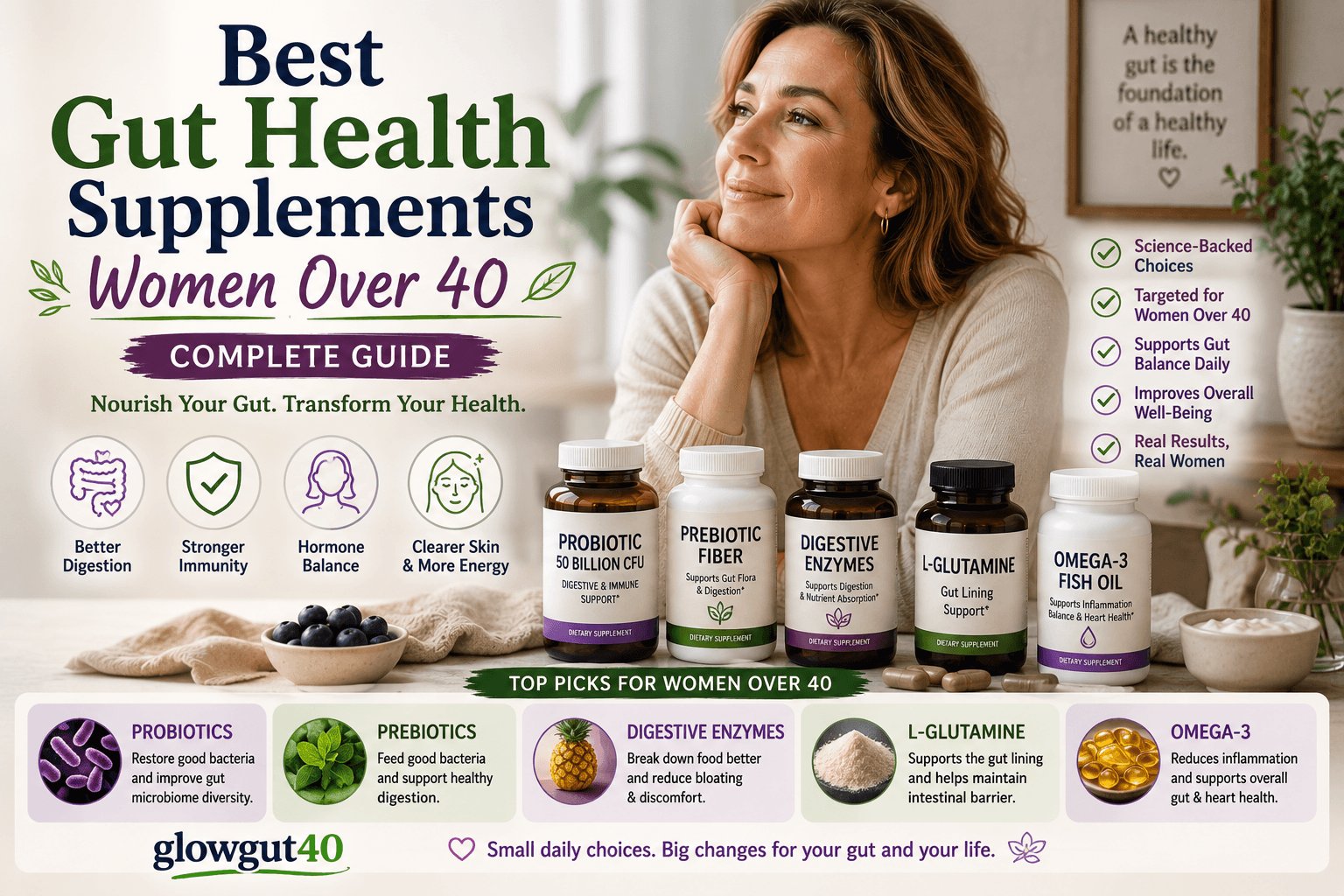
Best Gut Health Supplements for Women Over 40 Science-Backed, Ranked by Effectiveness — With Exact Dosages
The supplement aisle is overwhelming and expensive. Here’s exactly which gut health supplements actually work for women over 40 — based on clinical research, not marketing.
Illustration: Top 8 gut health supplements ranked by evidence strength for women over 40
“The supplement industry makes billions from people who don’t know what they actually need. Most gut health supplements are unnecessary. A few are genuinely life-changing. Here’s how to tell the difference.”
Walk into any Walmart, GNC, or Whole Foods in America and you’ll find an overwhelming wall of gut health supplements — probiotics, digestive enzymes, fiber powders, collagen, greens powders, and more. Each one promises to transform your gut health. Most won’t make a meaningful difference. A select few, taken correctly, can accelerate gut healing dramatically.
The critical rule: supplements support a gut-healing diet — they cannot replace one. If you’re still eating ultra-processed food, refined sugar, and seed oils daily, no supplement will undo that damage. Food changes must come first.
That said, for women over 40 who are already eating well and want to accelerate healing, the right supplements — at the right doses — can produce measurable improvements in gut lining integrity, microbiome diversity, inflammation levels, and overall gut function within 4–8 weeks.
Why Women Over 40 Have Different Gut Supplement Needs
The gut microbiome undergoes significant changes during perimenopause and menopause. Declining estrogen directly affects gut bacteria composition, gut lining integrity, and the gut immune system. Research published in Menopause journal found that women in perimenopause showed measurable reductions in beneficial Lactobacillus and Bifidobacterium populations — exactly the bacteria that maintain gut health, hormonal balance, and metabolic function.
Additionally, after 40, stomach acid production naturally decreases — reducing the efficiency of nutrient absorption. Vitamin D, zinc, magnesium, and B12 — all critical for gut health — become harder to absorb from food alone. This is one of the key reasons targeted supplementation becomes more valuable after 40 compared to earlier in life.
The eight supplements in this guide were selected specifically for their relevance to women over 40 — taking into account hormonal changes, natural microbiome decline, and the specific gut health challenges of this life stage.
The 8 Best Gut Health Supplements for Women Over 40
L-Glutamine is the most important and most evidence-backed supplement for gut health — particularly for women with leaky gut, IBS, or chronic gut inflammation. It is the primary amino acid fuel source for intestinal epithelial cells (the cells that line your gut wall), and supplementing it directly accelerates gut lining repair.
Research published in Clinical Nutrition confirmed that L-Glutamine supplementation significantly reduced intestinal permeability markers in patients with elevated gut leakage. A 2021 study in Nutrients found it specifically beneficial for women experiencing gut dysbiosis during hormonal transitions.
How it works: Colonocytes (gut lining cells) use glutamine as their primary fuel — much like muscles use glucose. Without adequate glutamine, gut lining cells cannot repair themselves quickly enough to maintain tight junction integrity. Supplementing ensures these cells have the fuel they need to heal continuously.
📦 Form: Unflavored powder mixed in water (most economical)
⏱️ When to expect results: 2–4 weeks of consistent use
✅ Best for: Leaky gut, bloating, IBS, post-antibiotic recovery
While whole food probiotics (kefir, kimchi, yogurt) should always be your primary source, a high-quality multi-strain probiotic supplement is particularly valuable for women over 40 who need to rapidly rebuild microbiome diversity after antibiotic use, illness, or significant gut dysbiosis.
The key differentiator between effective and ineffective probiotic supplements is strain specificity. Different strains do completely different things. For women over 40, the most researched and beneficial strains include:
- Lactobacillus rhamnosus GG — reduces gut permeability, supports immunity, helps with anxiety
- Bifidobacterium longum — reduces cortisol response, supports hormonal balance, improves sleep
- Lactobacillus acidophilus — supports digestion, reduces bloating, helps with vaginal health
- Bifidobacterium bifidum — reduces eczema, supports immune regulation, improves nutrient absorption
- Lactobacillus helveticus — reduces psychological distress, supports bone density (increasingly important after 40)
📦 Form: Capsule with enteric coating (protects from stomach acid)
⏱️ When to expect results: 2–6 weeks
✅ Best for: Post-antibiotic recovery, microbiome rebuilding, IBS, immunity
Zinc carnosine is a chelated form of zinc specifically researched for gut health — and it has some of the most impressive clinical data of any gut supplement available. It works by directly stabilizing the tight junction proteins that keep the gut wall sealed, reducing gut inflammation, and accelerating mucosal healing.
A landmark study published in Inflammatory Bowel Diseases found that zinc carnosine significantly reduced intestinal permeability and improved gut lining integrity in patients with elevated leaky gut markers. A 2020 study in Clinical Nutrition found it effective for reducing gut inflammation specifically in women experiencing hormonal-related gut changes.
Zinc deficiency — which affects over 12% of American women over 40 — directly weakens tight junction proteins. Even mild zinc insufficiency allows the gut wall to become more porous over time. Zinc carnosine addresses this at the molecular level.
📦 Form: Capsule (look for PepZin GI — the most studied form)
⏱️ When to expect results: 4–8 weeks
✅ Best for: Leaky gut, gastric ulcers, NSAID-related gut damage, tight junction repair
Vitamin D deficiency affects over 40% of American adults according to the NIH — and its impact on gut health is profound and largely underappreciated. Vitamin D3 directly regulates the expression of tight junction proteins, maintains the gut’s protective mucus layer, modulates the gut immune response, and supports the growth of beneficial bacteria.
Research published in Gut journal found that vitamin D deficiency was significantly associated with increased intestinal permeability, dysbiosis, and gut inflammation. Supplementing to optimal levels (60–80 ng/mL in blood tests) was shown to improve gut barrier function measurably within 8 weeks.
For women over 40, vitamin D3 is doubly important: it also supports bone density (critical during and after menopause), immune function, mood regulation, and cardiovascular health — all areas of increased concern after 40. The K2 form directs calcium to bones rather than arteries — always take D3 with K2.
📦 Form: Softgel with K2 (MK-7 form of K2 is most bioavailable)
⏱️ When to expect results: 6–12 weeks to raise blood levels
✅ Best for: Leaky gut, immune support, bone health, mood, hormonal balance
Collagen peptides have become one of the most popular supplements in America — and for gut health, the benefits are real. Collagen provides glycine, proline, and hydroxyproline — amino acids that are the structural building blocks of the connective tissue forming the gut lining, the extracellular matrix supporting gut cells, and the tight junction scaffolding that keeps the gut wall sealed.
Bone broth is the whole-food equivalent and equally effective. For women who want a more concentrated, convenient delivery, collagen peptide powder (hydrolyzed for maximum absorption) mixed into coffee, smoothies, or soups provides consistent daily delivery of these critical gut-building amino acids.
For women over 40, collagen supplements serve a dual purpose — supporting gut healing while simultaneously addressing the accelerated collagen decline that begins in the mid-30s and contributes to skin aging, joint pain, and reduced muscle recovery.
📦 Form: Hydrolyzed collagen peptide powder (dissolves in hot or cold liquids)
⏱️ When to expect results: 4–8 weeks for gut; 8–12 weeks for skin
✅ Best for: Leaky gut repair, skin, joints, post-antibiotic gut healing
Omega-3 fatty acids — specifically EPA and DHA from fish oil — are among the most researched anti-inflammatory compounds in existence, and their impact on gut health is both direct and profound. EPA and DHA directly reduce the production of pro-inflammatory cytokines (IL-6, TNF-alpha) that drive gut inflammation, intestinal permeability, and dysbiosis.
Research published in Gut journal found that omega-3 supplementation significantly reduced zonulin levels (the protein that opens tight junctions) and improved gut barrier function in adults with elevated inflammatory markers. For women over 40 — who face increasing cardiovascular, joint, and cognitive health challenges — omega-3s deliver benefits across multiple systems simultaneously.
📦 Form: Triglyceride form (better absorbed than ethyl ester form) — look for “rTG” on label
⏱️ When to expect results: 4–8 weeks
✅ Best for: Gut inflammation, leaky gut, cardiovascular health, joint pain, brain health
Quercetin is a powerful plant flavonoid that specifically targets the tight junction proteins (occludin, claudin, and ZO-1) that keep the gut wall sealed. Multiple studies confirm that quercetin directly upregulates these proteins, reducing intestinal permeability and gut inflammation simultaneously.
It’s found naturally in onions, apples, capers, and red wine — but in quantities too small for therapeutic effect. Supplemental quercetin provides the concentrated dose needed to meaningfully strengthen gut barrier function. Research from Cornell University found quercetin reduced gut permeability by up to 45% in subjects with elevated baseline permeability.
📦 Form: Quercetin phytosome (most bioavailable form; 20x better absorbed than standard quercetin)
⏱️ When to expect results: 4–6 weeks
✅ Best for: Leaky gut, seasonal allergies, gut inflammation, skin health
Psyllium husk is soluble fiber derived from the seeds of Plantago ovata — and it has an FDA-approved health claim for reducing LDL cholesterol, making it one of the few supplements with official FDA recognition of its health benefits. For gut health, psyllium acts as a powerful prebiotic that feeds SCFA-producing bacteria, regulates bowel movements, and reduces intestinal inflammation.
For women over 40 who struggle to get adequate dietary fiber (the average American eats only 10–15g/day vs. the recommended 25–38g), psyllium husk is the most effective and affordable fiber supplement available. It feeds the exact gut bacteria that produce butyrate — the gut lining’s primary fuel source.
📦 Form: Whole husk powder (Metamucil is widely available; choose unflavored, unsweetened)
⏱️ When to expect results: 1–2 weeks for digestion; 4–6 weeks for microbiome benefits
✅ Best for: Constipation, cholesterol reduction, blood sugar control, microbiome diversity
📊 Quick Comparison: All 8 Supplements at a Glance
| Supplement | Daily Dose | Leaky Gut | Microbiome | Inflammation | Over-40 Bonus |
|---|---|---|---|---|---|
| 💊 L-Glutamine | 5g × 2 | ✅✅✅ | ✅ | ✅✅ | Gut repair |
| 🦠 Probiotics | 10–50B CFUs | ✅✅ | ✅✅✅ | ✅✅ | Hormonal balance |
| 🧬 Zinc Carnosine | 75–150mg | ✅✅✅ | ✅ | ✅✅ | Immune support |
| ☀️ Vitamin D3+K2 | 2000–5000 IU | ✅✅ | ✅✅ | ✅✅ | Bone + mood |
| 🍖 Collagen | 10–20g | ✅✅ | — | ✅ | Skin + joints |
| 🐟 Omega-3 | 2–3g EPA+DHA | ✅✅ | ✅ | ✅✅✅ | Heart + brain |
| 🍎 Quercetin | 500–1000mg | ✅✅ | — | ✅✅ | Allergy relief |
| 🌱 Psyllium Husk | 5–10g | ✅ | ✅✅✅ | ✅ | Cholesterol |
🧮 Not Sure Which Supplements You Actually Need?
Take the free GlowGut40 Gut Score Calculator — get your personal gut health score and targeted recommendations in 2 minutes. Check My Gut Score Free →⚠️ Common Supplement Mistakes Women Over 40 Make
No supplement overcomes a diet of refined sugar, seed oils, and ultra-processed food. Supplements accelerate healing when diet is already clean — they cannot replace dietary changes. Food first, always.
Single-strain, low-CFU probiotics sold at dollar stores or discount pharmacies have minimal clinical benefit. For meaningful gut health results, you need multiple strains at 10+ billion CFUs, with guaranteed live-at-expiry dating and enteric coating.
Starting 8 new supplements simultaneously makes it impossible to identify which one is helping — or causing side effects. Start with L-Glutamine and Vitamin D3 (the two most impactful), and add one new supplement every 2 weeks.
Vitamins D3, K2, and omega-3 fish oil are fat-soluble — they require dietary fat to absorb properly. Taking them on an empty stomach wastes up to 50% of the dose. Always take with a meal containing healthy fat (avocado, olive oil, nuts).
Most gut health supplements require 4–8 weeks of consistent daily use before producing measurable results. The gut lining regenerates every 3–5 days, but microbiome diversity changes take weeks to consolidate. Patience and consistency are non-negotiable.
❓ Frequently Asked Questions
L-Glutamine is the single most evidence-backed gut health supplement for women over 40 — particularly for those with leaky gut, IBS, or post-antibiotic gut damage. It directly fuels gut lining cell repair and has strong clinical evidence for reducing intestinal permeability. If you only start with one supplement, start with L-Glutamine (5g twice daily) alongside Vitamin D3 (which over 40% of Americans are deficient in).
For most people who eat a diverse, fiber-rich diet with daily fermented foods, whole-food nutrition is sufficient for gut health maintenance. Supplements become particularly valuable when: recovering from antibiotics, healing diagnosed leaky gut or IBS, during perimenopause/menopause (when gut bacteria naturally decline), when specific nutrient deficiencies are present (especially vitamin D), or when dietary restrictions limit food-based options. Use supplements to fill genuine gaps — not as a replacement for real food.
For acute gut healing (post-antibiotic, leaky gut repair): 3–6 months of consistent supplementation is typically recommended, then reassess. For maintenance: Vitamin D3, omega-3, and probiotic supplements can be taken long-term with minimal risk. L-Glutamine and zinc carnosine are generally taken therapeutically for 3–6 months, then transitioned to food-based maintenance. Always reassess every 3 months and consult your healthcare provider for personalized guidance.
Technically yes — there are no known dangerous interactions between these 8 supplements. However, starting all 8 simultaneously is not recommended. It’s impossible to identify which supplements are helping and which might be causing side effects. Start with 2 (L-Glutamine + Vitamin D3), then add one new supplement every 2 weeks while monitoring how you feel. This approach identifies what works for your specific body and prevents supplement overwhelm.
Digestive enzymes can be helpful — particularly for women over 40 whose stomach acid production naturally decreases, leading to incomplete digestion and increased gas and bloating. They are most useful short-term (during gut healing) to reduce the undigested food particles that irritate the gut lining. However, they are a symptomatic aid rather than a root cause treatment. Address the underlying gut health issues (dysbiosis, leaky gut) with the supplements above, and enzyme dependency typically decreases over time.
For bloating specifically: (1) Multi-strain probiotics — rebalance the bacteria causing improper fermentation, (2) L-Glutamine — repairs the gut lining, reducing food particle leakage that triggers immune responses, (3) Digestive enzymes (short-term) — improve food breakdown reducing fermentation gases, (4) Psyllium husk — regulates gut transit and feeds bacteria that reduce gas production. Addressing the diet (cutting ultra-processed foods and artificial sweeteners) produces the fastest bloating relief — supplement this with probiotics and L-Glutamine for best results.
Final Thoughts: Supplement Smart, Not Expensive
The gut health supplement market is enormous — and mostly unnecessary for people who eat well. But for women over 40 navigating hormonal changes, microbiome decline, and the cumulative effects of years of modern Western diet, a targeted, evidence-based supplement protocol can meaningfully accelerate healing.
Start simple: L-Glutamine and Vitamin D3. Add a high-quality multi-strain probiotic. Eat daily fermented foods alongside your supplements. And let the food do most of the work — because no supplement will ever outperform a diet built around whole plants, fermented foods, omega-3 rich fish, and adequate fiber.
Supplements are the accelerator. Food is the engine. Both working together is where the real transformation happens.
Ready to Build Your Complete Gut Healing Protocol?
Explore more science-backed gut health guides on GlowGut40 — your trusted guide for healing from the inside out.
